
Linalool in Skincare: Is It Safe, What Does It Do, and Should You Avoid It?
If you've ever opened a face cream and been greeted by a soft, floral scent, reminiscent of lavender or a fresh citrus grove. You've likely encountered linalool. It's one of the most widely used fragrance ingredients in the world, found in everything from high-end serums to organic body washes.
But as fragrance-free skincare becomes more popular, many consumers are asking: is linalool safe for skin? Or is it a hidden irritant waiting to cause problems?
In this guide, we break down the science, the risks, the smell, the allergen concerns, pregnancy safety, vegan status, and everything else you need to know before using products that contain this common INCI ingredient.
What Is Linalool?
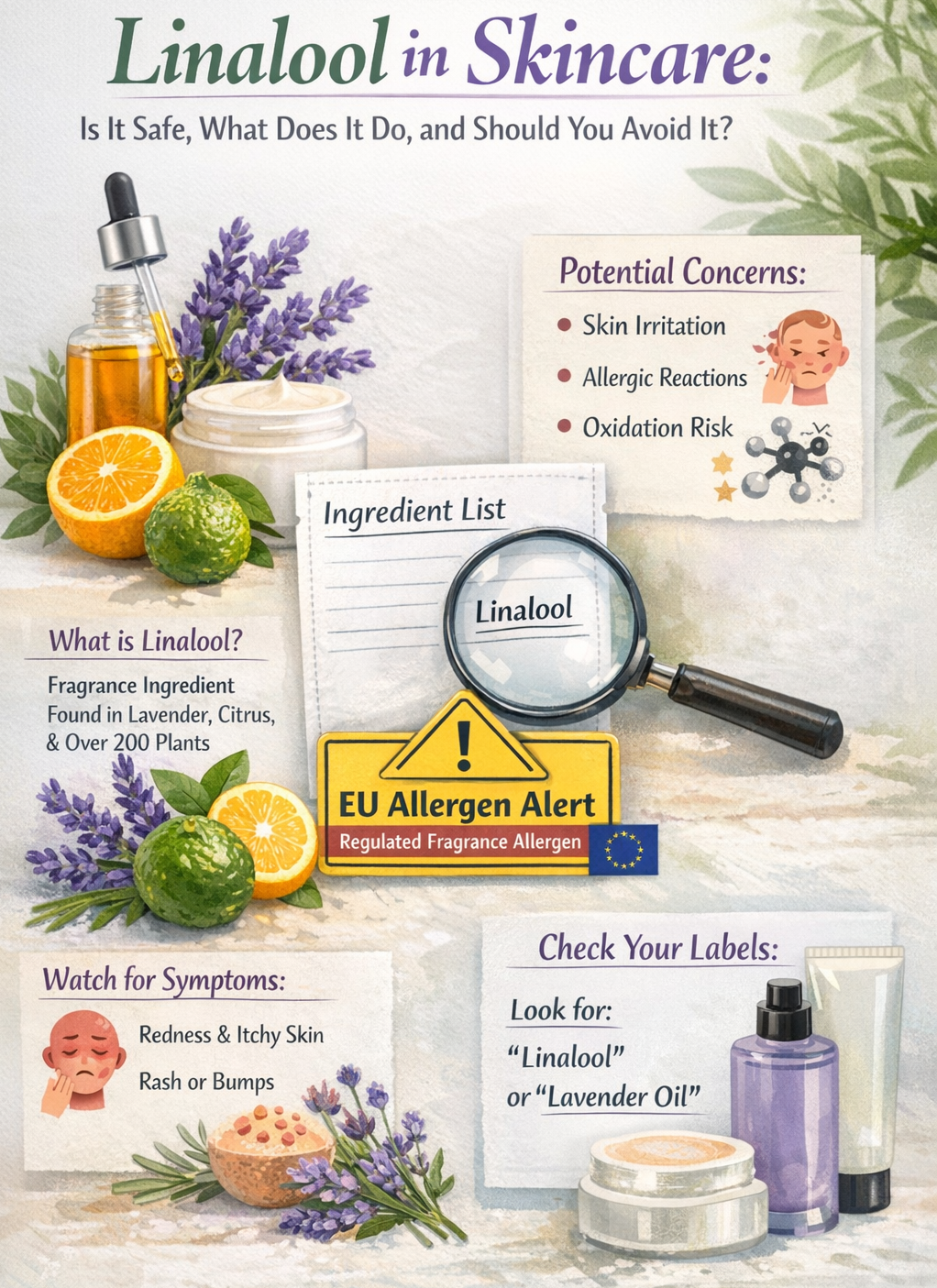
Linalool is a naturally occurring terpene alcohol found in over 200 plant species. It is the primary compound responsible for the characteristic soothing scent of lavender, coriander, bergamot, and mint. In chemistry, it belongs to the monoterpene family and has the molecular formula C₁₀H₁₈O.
What Is Linalool Used For?
In skincare and cosmetics, linalool is used primarily for its aromatic properties—it makes products smell pleasant and "clean." It also has minor antimicrobial properties, which can help support a product's preservative system. You'll find it listed as an INCI ingredient on the back of moisturizers, serums, shampoos, and body lotions.
Beyond cosmetics, linalool is used in perfumery, household cleaning products, and even food flavoring (it is approved as a food additive in many regions).
What Does Linalool Smell Like?
Linalool has a soft, floral, slightly woody scent with clean, fresh undertones. Most people describe the linalool odor as reminiscent of lavender with hints of rose and citrus. Because this scent profile is widely perceived as universally pleasant, it became one of the most popular fragrance ingredients in the cosmetics industry.
If you enjoy the smell of lavender essential oil, you are largely enjoying linalool it typically makes up 25–45% of lavender oil's composition.
Where Is Linalool Found?
Linalool is ubiquitous. Because it is affordable and smells universally "clean," it appears in a huge range of products:
Essential Oils with High Linalool Content
Is Linalool Safe for Skin?
For most people, yes — linalool is considered safe.
Regulatory bodies including the FDA (United States), the European Commission, and the Cosmetic Ingredient Review (CIR) Expert Panel have all assessed linalool and found it safe for use in cosmetics at typical concentrations.
EU Allergen Classification
However, the European Union classifies linalool as one of 26 regulated fragrance allergens. This does not mean it is toxic. It means it has a higher-than-average potential to cause a skin reaction in sensitized individuals. As a result, EU law requires brands to list linalool individually on the label if it exceeds 0.01% in rinse-off products or 0.001% in leave-on products—rather than hiding it under the generic term "Fragrance" or "Parfum."
Is Linalool Toxic to Humans?
Linalool is not considered toxic to humans at concentrations used in cosmetics. It has a wide safety margin and is not classified as carcinogenic, mutagenic, or reproductively toxic by any major regulatory agency. The risk it poses is specifically allergic contact sensitization in a subset of people who develop a sensitivity to it.
Linalool Safety in Cosmetics: The Oxidation Problem
The real nuance of linalool safety comes down to oxidation. Linalool itself is not strongly sensitizing. The problem arises when linalool is exposed to air (oxygen) and oxidizes, forming compounds called hydroperoxides of linalool. These hydroperoxides are potent skin sensitizers.
This means:
Practical tip: If you have a facial oil or serum containing linalool and it has been open for over a year, the sensitization risk is meaningfully higher than when it was first opened.
Linalool Side Effects and Allergy Symptoms
Most people will never experience a reaction. But for those with linalool sensitivity or an existing linalool allergy, symptoms of contact dermatitis can include:
Linalool Allergy: How Common Is It?
Studies suggest linalool allergy affects roughly 1–3% of the general population when oxidized linalool is tested. Patch testing by a dermatologist is the gold standard for confirming a linalool allergy. If you suspect this is a trigger for your skin, seek a formal patch test rather than self-diagnosing.
Linalool and Pregnancy: Is It Safe?
Is linalool pregnancy safe? This is a common concern, especially for those using essential oil-heavy skincare.
Currently, there is no strong evidence that topically applied linalool poses a danger during pregnancy at the concentrations used in skincare products. It is not classified as a reproductive or developmental toxin by major regulatory bodies.
That said, some caution is advised around essential oils with very high linalool concentrations (such as rosewood or ho wood oil) during the first trimester, as a general principle of minimizing potent bioactive compounds during early pregnancy. Always consult your healthcare provider if you are unsure about specific products during pregnancy.
Is Linalool Vegan?
Yes — linalool is vegan.
Linalool is derived from plants (or synthesized from petrochemical sources via a route that does not involve animal products). Whether naturally sourced from lavender or bergamot, or produced synthetically, it does not involve animal-derived ingredients or animal testing at the ingredient level.
If vegan certification is important to you, look for brands certified by organizations like The Vegan Society, as this covers the full product formulation and manufacturing process.
Linalool vs. Lanolin: Are They the Same?
No — linalool and lanolin are completely different ingredients.
This is a common point of confusion. Linalool and lanolin share no chemical relationship whatsoever the name similarity is purely coincidental and a frequent source of confusion. Linalool is a plant-derived (or synthetically produced) terpene alcohol used primarily as a fragrance ingredient with minor antimicrobial properties. Lanolin, by contrast, is a waxy substance derived from sheep's wool grease, used as an emollient and moisturizer. This also means linalool is vegan, while lanolin is not. Both can cause allergic reactions, linalool is classified as one of the EU's 26 regulated fragrance allergens, while lanolin is a well-known contact allergen in its own right but through entirely different mechanisms. Even their scents differ: linalool smells floral and lavender-like, while lanolin has a faint, waxy odor. They serve completely different purposes in a formula and should never be conflated.
Linalool Benefits for Skin
While linalool is primarily a fragrance ingredient, it does offer some secondary benefits:
How to Spot Linalool on Ingredient Labels
When scanning an INCI ingredient list, look for:
Position on the list matters. Ingredients listed at the very end are typically at very low concentrations. However, if you have reactive or sensitized skin, even trace amounts of oxidized linalool can trigger a response.
Should You Avoid Linalool?
Our verdict: it depends on your skin type.
If you have normal or combination skin, linalool is generally fine. The risk is low as long as your products are fresh and well-sealed to prevent oxidation.
If you have sensitive or reactive skin, proceed with caution. Always patch test new products before applying them to your face, and pay attention to whether linalool appears high on the ingredient list.
If you have a history of eczema or contact dermatitis, consider avoiding linalool-containing products altogether, particularly leave-on formulas like moisturizers and serums, where the ingredient has prolonged contact with skin.
If you have a confirmed linalool allergy, avoid it entirely. That includes products containing lavender, bergamot, or rosewood essential oils, which are naturally high in linalool even when the ingredient itself isn't listed separately.
Is Linalool hiding in your current routine? Don't guess—verify. Use the Skinwis Ingredient Analyzer to upload your product labels and see if Linalool is standing in the way of your skin goals.
Products Commonly Containing Linalool
Frequently Asked Questions
Is linalool safe in skincare?
Yes, for most people. It is approved by major regulatory bodies globally. The main risk is allergic sensitization in a small subset of individuals, particularly with oxidized linalool.
Is linalool toxic?
No. At concentrations used in cosmetics, linalool is not toxic to humans. It is not classified as a carcinogen, mutagen, or reproductive toxin.
Is linalool vegan?
Yes. Linalool is plant-derived or synthetically produced and involves no animal products.
Is linalool pregnancy safe?
There is no evidence of harm from topical exposure at typical cosmetic concentrations. Consult your doctor if you have specific concerns.
What does linalool smell like?
Soft, floral, and slightly woody, most commonly described as lavender-like with fresh, clean undertones.
Is linalool the same as lanolin?
No. They are completely unrelated ingredients. Linalool is a plant-derived fragrance terpene; lanolin is an animal-derived emollient from sheep's wool.