The Ultimate Guide to Hydrating & Moisturizing Ingredients: Benefits, Safety, and Skin Type Compatibility
By Jessy Hoper •
Finding the right skincare can feel like learning a second language. You see terms like "humectant," "emollient," and "occlusive" on every bottle, but what do they actually do for your face?
The Ultimate Guide to Hydrating & Moisturizing Ingredients: Benefits, Safety, and Skin Type Compatibility
Finding the right skincare can feel like learning a second language. You see terms like "humectant," "emollient," and "occlusive" on every bottle, but what do they actually do for your face?
Whether you are battling winter dryness or trying to balance oily skin, understanding hydrating and moisturizing ingredients is the secret to a healthy glow. In this guide, we’ll break down the top 10 ingredients, their safety profiles, comedogenic ratings, and how to choose the best ones for your specific skin type.
What is the Difference Between Hydrating and Moisturizing?
While we often use the terms interchangeably, they serve two distinct functions in skin physiology.
Hydrating Ingredients (Humectants): These act like magnets. They pull water into the top layer of your skin (the epidermis) from the air or from deeper layers of the skin. They increase the water content of your cells.
Moisturizing Ingredients (Emollients & Occlusives): These act like a seal. They fill in the gaps between skin cells with lipids (fats) and create a barrier to prevent Transepidermal Water Loss (TEWL), which is just a fancy way of saying "water evaporating off your skin."
To have healthy skin, you usually need both: something to bring the water in (hydration) and something to keep it there (moisturization).
Chemical Classification: Polysaccharide (Glycosaminoglycan)
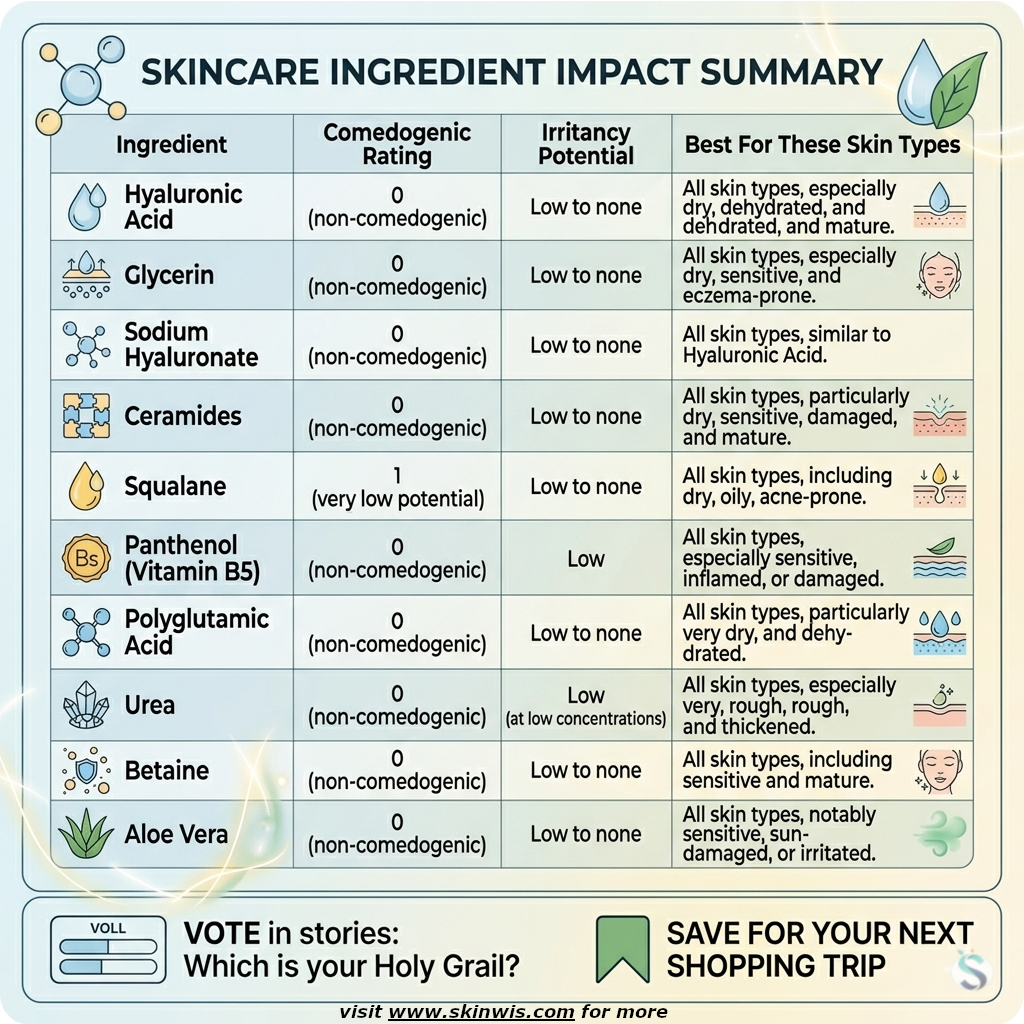
How it Works: HA is a powerhouse humectant naturally found in our skin. It can hold up to 1,000 times its weight in water, making it the gold standard for surface hydration.
Benefits: Instant plumping, smoothing of fine lines, and soothing dehydration.
Skin Types: All skin types (oily to dry).
Comedogenic Rating: 0 (Won't clog pores).
Irritancy/Safety: Very low risk. It is naturally occurring in the body.
How it Works: Glycerin is a "workhorse" humectant. It mimics the skin's Natural Moisturizing Factor (NMF) and helps maintain the liquid crystal structure of skin lipids (Milani et al., 2017).
Benefits: Deep hydration and skin barrier repair.
Skin Types: Excellent for sensitive and very dry skin.
Comedogenic Rating: 0.
Irritancy/Safety: Non-irritating; safe even for compromised skin.
How it Works: Ceramides make up about 50% of your skin's natural barrier. They act like the "mortar" between your skin cell "bricks," preventing moisture from escaping.
Benefits: Barrier repair, protection against environmental irritants, and eczema relief (Coderch et al., 2003).
Skin Types: Dry, sensitive, and aging skin.
Comedogenic Rating: Usually 0–1 (Depending on the carrier oil).
Irritancy/Safety: Extremely low; essential for sensitive skin.
Common Products: Rich creams and barrier-repair balms.
How it Works: It is both a humectant and an emollient. It helps the skin produce more lipids and has significant anti-inflammatory properties (Ebner et al., 2002).
Benefits: Wound healing, redness reduction, and deep soothing.
Skin Types: Sensitive, irritated, or post-procedure skin.
Comedogenic Rating: 0.
Irritancy/Safety: Very safe; often used in baby products.
Common Products: Soothing balms and after-sun care.
How it Works: Derived from fermented soybeans, PGA can hold even more water than Hyaluronic Acid. It forms a thin, silk-like film on the skin surface to lock in moisture.
Benefits: High-gloss "glass skin" finish and extreme hydration.
Chemical Classification: Carbamide (Organic compound)
How it Works: At low concentrations (below 10%), it is a powerful humectant. At higher concentrations, it becomes a "keratolytic," meaning it gently dissolves dead skin cells (Lodén, 2012).
Benefits: Intense hydration and smoothing of rough, "bumpy" skin (Keratosis Pilaris).
Skin Types: Very dry, flaky, or calloused skin.
Comedogenic Rating: 0.
Irritancy/Safety: Can tingle on broken skin; avoid high % on the face unless directed by a pro.
Common Products: Foot creams and specialized face lotions for dry skin.
Chemical Classification: Osmolyte (Amino acid derivative)
How it Works: It helps cells maintain water balance (osmotic pressure) without interfering with cellular function. It also reduces the stickiness of cosmetic formulas.
Benefits: Soothing, moisturizing, and anti-irritant.
Chemical Classification: Botanical Extract/Polysaccharide
How it Works: Aloe is composed of 99% water plus vitamins, minerals, and amino acids. It provides a cooling, film-forming layer that hydrates and heals.
Benefits: Cooling, anti-inflammatory, and lightweight hydration.
Skin Types: Oily, acne-prone, and sunburnt skin.
Comedogenic Rating: 0.
Irritancy/Safety: Generally safe, though some people are allergic to the latex in the raw plant.
Common Products: Gels, mists, and lightweight lotions.
Creamy Second: Apply your moisturizer (Ceramides, Glycerin) to seal in the water.
Oily Last: If using a pure oil like Squalane, pat it on last to create a final occlusive seal.
FAQ (Frequently Asked Questions)
What are hydrating & moisturizing ingredients? Hydrating ingredients (humectants) attract water to the skin cells, while moisturizing ingredients (emollients/occlusives) lock that water in and soften the skin surface.
How do these ingredients help skin? They prevent dryness, repair the protective barrier, smooth fine lines caused by dehydration, and soothe irritation from environmental stressors.
Which skin types benefit most from hydrating vs moisturizing ingredients? All skin types need hydration (water). However, dry skin types benefit more from heavy moisturizing (oils/fats), while oily skin types should prioritize lightweight hydrating serums.
Which products typically contain these ingredients? You will find them in serums, essences, daily moisturizers, night creams, and even some sunscreens.
How to shop for products with these ingredients? Check the first 5 ingredients for humectants like Glycerin or HA. For barrier repair, ensure Ceramides are present. Avoid high fragrance or drying alcohols if you have sensitive skin.
How long until I see results? Hydration (plumping) is often instant. Barrier repair and texture improvements typically take 2 to 4 weeks of consistent use.
What ingredients can be paired with these? They pair beautifully with "actives" like Retinol, Vitamin C, and exfoliating acids, as they help mitigate the irritation those ingredients can cause.
Do these ingredients cause purging? No. Hydrating and moisturizing ingredients do not increase cell turnover, so they do not cause purging. If you break out, it is likely a standard reaction to a specific formulation or a clogged pore.
Scientific References
Milani, M., & Sparavigna, A. (2017). The 24-hour skin hydration and barrier function effects of a hyaluronic acid and glycerin serum. Clinical, Cosmetic and Investigational Dermatology.
Coderch, L., et al. (2003). Ceramides and Skin Function. American Journal of Clinical Dermatology.
Ebner, F., et al. (2002). Topical use of dexpanthenol in skin disorders. American Journal of Clinical Dermatology.
Lodén, M. (2012). Effect of moisturizers on epidermal barrier function. Clinics in Dermatology.
Sethi, A., et al. (2016). Moisturizers: The Slippery Road. Indian Journal of Dermatology.
Ganceviciene, R., et al. (2012). Skin anti-aging strategies. Dermato-endocrinology.