Top Anti-Aging Ingredients: Benefits, Safety, Comedogenic Rating, and Best Skin Types
By Steffy Albert •
Top Anti-Aging Ingredients: Benefits, Safety, Comedogenic Rating, and Best Skin Types
We all want that "lit-from-within" glow, but as time passes, our skin’s natural processes slow down. Fine lines appear, skin loses its bounce, and texture becomes uneven. This is where anti-aging ingredients come in.
Top Anti-Aging Ingredients: Benefits, Safety, Comedogenic Rating, and Best Skin Types
We all want that "lit-from-within" glow, but as time passes, our skin’s natural processes slow down. Fine lines appear, skin loses its bounce, and texture becomes uneven. This is where anti-aging ingredients come in.
In this guide, we will explore the science-backed ingredients that actually make a difference. From the gold-standard Retinol to the plant-based Bakuchiol, we’ll break down their safety, irritancy potential, and which skin types they suit best so you can build a routine that actually works.
How Do Anti-Aging Ingredients Actually Work?
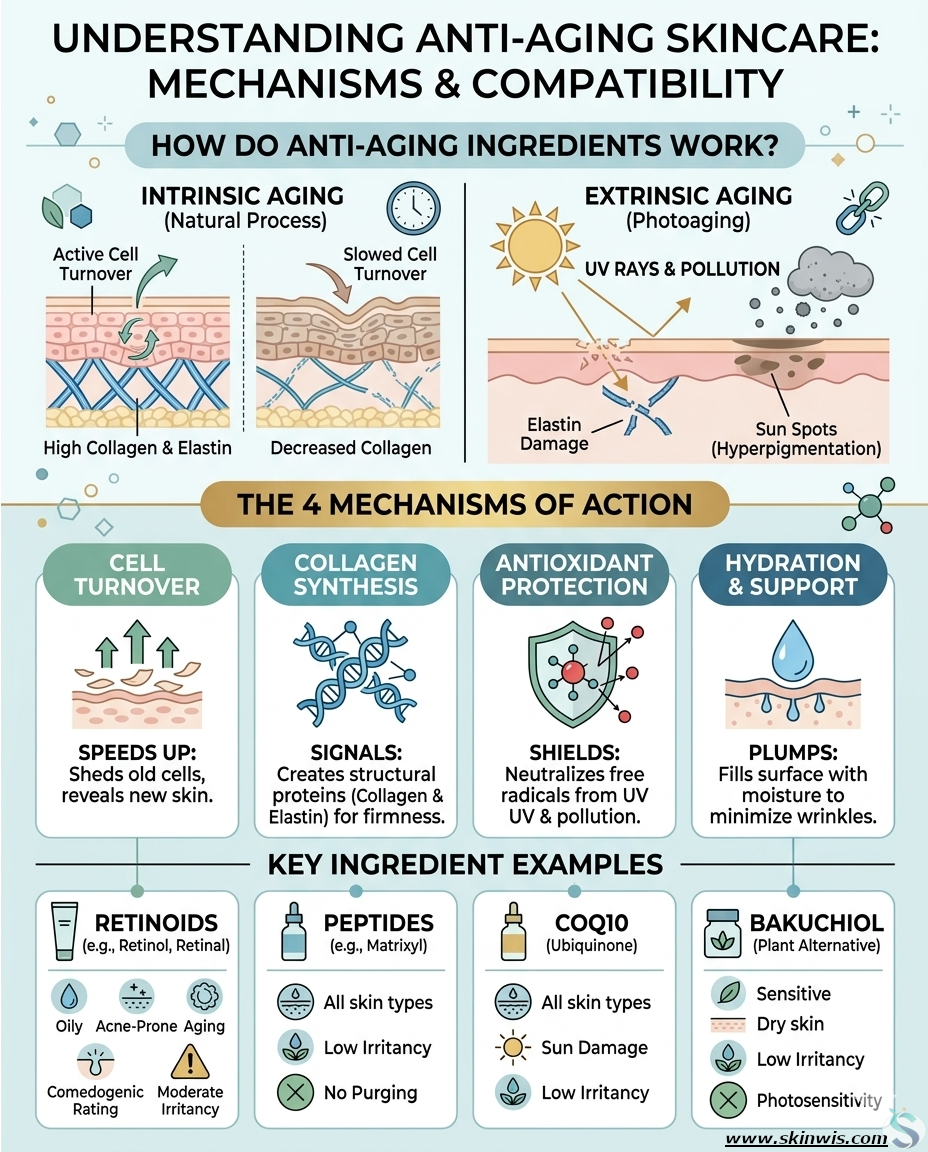
To understand how these ingredients work, we first have to look at why skin ages. Skin aging happens in two ways:
Intrinsic Aging: The natural chronological process where cell turnover slows down and collagen production drops.
Extrinsic Aging (Photoaging): Damage caused by external factors, primarily UV rays and pollution, which break down elastin and cause "sun spots."
The Mechanisms of Action:
Cell Turnover: Ingredients like retinoids speed up the rate at which old cells shed and new ones emerge.
Collagen Synthesis: Some ingredients signal the skin to create more "structural proteins" (collagen and elastin) to keep skin firm.
Antioxidant Protection: These act as shields, neutralizing "free radicals" that damage skin cells.
Hydration & Support: Ingredients that plump the surface to make wrinkles look less prominent.
Chemical Classification: Vitamin A derivative (Retinoid)
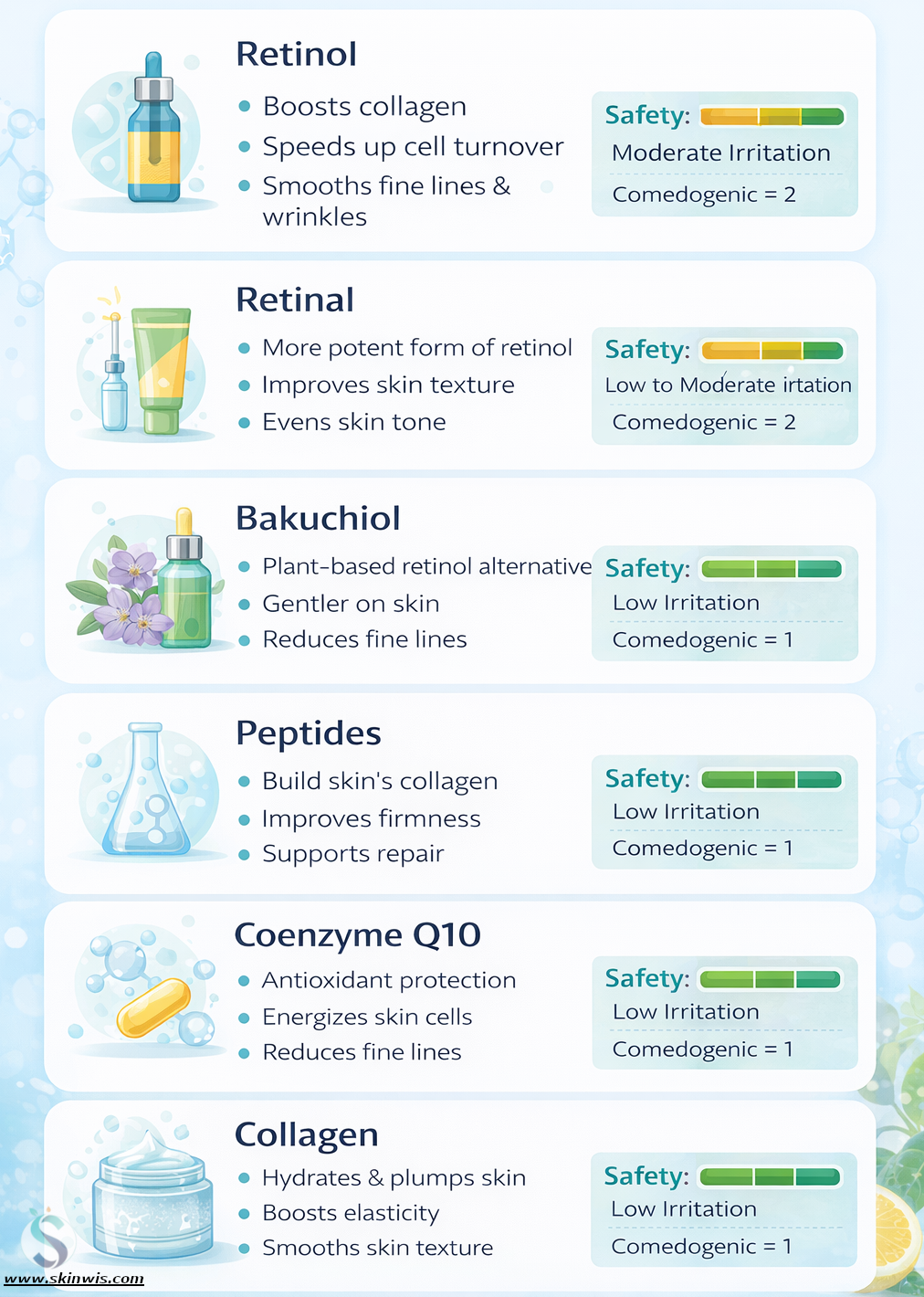
How it Works: Once applied, Retinol converts into Retinoic Acid in the skin. It binds to nuclear receptors to increase cell turnover and stimulate collagen production (Zasada & Budzisz, 2019).
Benefits: Reduces fine lines, improves texture, and fades hyperpigmentation.
Skin Types: Oily, acne-prone, and aging skin. Use with caution on dry/sensitive skin.
Comedogenic Rating: 1 (Retinol itself does not clog pores).
Irritancy/Safety: High. It can cause redness, peeling, and dryness (the "Retinol Uglies"). It increases photosensitivity, so sunscreen is mandatory.
How it Works:Retinal is the direct precursor to Retinoic Acid. While Retinol requires two conversion steps to become active, Retinal only requires one, making it roughly 11 times faster than Retinol.
Benefits: Faster results for wrinkles and potent antibacterial properties for acne.
Skin Types: Oily, acne-prone, and those who have "graduated" from standard Retinol.
Comedogenic Rating: 1.
Irritancy/Safety: Moderate to high. Often better tolerated than its strength suggests, but still requires "sandwiching" with moisturizer.
Common Products: High-performance night serums.
Product Example:Medik8 Crystal Retinal. Popular for its various strength levels (1, 3, 6, 10).
Shopping Tip: It is usually bright yellow; if the product is white, it likely contains very little Retinal.
Timeline: 4–8 weeks for texture; 12 weeks for lines.
How it Works: Often called "nature's retinol," it doesn't actually belong to the Vitamin A family, but it triggers the same gene expression in the skin to boost collagen (Dhaliwal et al., 2019).
Benefits: Smoothing and firming without the irritation or sun sensitivity of retinoids.
Skin Types: Sensitive, dry, and those pregnant or breastfeeding (always consult a doctor).
Comedogenic Rating: 1.
Irritancy/Safety: Very low. It is photostable (can be used in the morning).
Common Products: Face oils and "sensitive" anti-aging serums.
Chemical Classification: Short chains of Amino Acids
How it Works: They act as "messengers." When collagen breaks down, peptides tell the skin it's time to build more. Specific types, like "neuro-peptides," can subtly relax facial muscles (like a very mild "Botox in a bottle" effect).
Benefits: Firming, skin barrier support, and improved elasticity (Schagen, 2017).
Skin Types: All skin types, especially sensitive or aging skin.
Comedogenic Rating: 1.
Irritancy/Safety: Very low. Extremely safe for long-term use.
Chemical Classification: Benzoquinone (Antioxidant)
How it Works: It is a naturally occurring enzyme in our cells that aids in energy production. Topically, it acts as a powerful antioxidant, protecting skin from oxidative stress and UV damage (Knott et al., 2015).
Benefits: Energizes skin repair, reduces sun damage, and evens skin tone.
Skin Types: All, particularly those concerned with environmental damage.
Comedogenic Rating: 2 (Low, but those with very oily skin should monitor).
Irritancy/Safety: Very low. Great for people who can't tolerate Vitamin C.
Common Products: Day creams and antioxidant serums.
How it Works:Important Note: Topical collagen molecules are too large to actually penetrate the dermis and "replace" your skin's collagen. Instead, it acts as a phenomenal humectant, sitting on the surface to bind moisture.
Benefits: Intense hydration and temporary plumping of surface fine lines.
Skin Types: Dry, dehydrated, and mature skin.
Comedogenic Rating: 1.
Irritancy/Safety: Very low.
Common Products: Sheet masks and rich moisturizers.
How it Works: Similar to collagen, topical elastin cannot "re-weave" itself into your skin's architecture. It functions as a conditioning agent that forms a protective, moisture-locking film.
Benefits: Skin softness, flexibility, and hydration.
Night (Repair): Cleanse -> Retinoid (Retinol/Retinal) -> Moisturizer.
3. Combining Ingredients Safely
Don't use multiple retinoids at once. Instead, "layer" by function. For example, use a Peptide moisturizer over your Retinol serum to boost firming while reducing the risk of irritation.
FAQ (Frequently Asked Questions)
What are anti-aging ingredients? They are active compounds designed to slow down or reverse the visible signs of aging, such as wrinkles, sagging, and dark spots, by boosting collagen or protecting against damage.
How do these ingredients help skin? They work by speeding up cell renewal, stimulating the production of structural proteins (collagen/elastin), and neutralizing environmental damage from the sun and pollution.
Which skin types benefit most from anti-aging ingredients? While all types benefit, those with mature, sun-damaged, or "tired" skin see the most dramatic results. Oily types benefit from the pore-clearing effects of retinoids.
Which products typically contain these ingredients? You will find them most concentrated in "treatment" steps like serums, although they are frequently added to night creams and eye treatments.
How to shop for products with these ingredients? Check for "active" levels of ingredients (like 0.3%+ Retinol or 1% Bakuchiol). Avoid products in clear jars, as light and air can degrade Retinol and CoQ10.
How long until I see results from these ingredients? Skin takes about 28–40 days to renew itself. You will see hydration quickly, but structural changes like wrinkle reduction usually take 3 to 6 months of consistent use.
What ingredients can be paired with these?Niacinamide and Ceramides are perfect partners for anti-aging actives because they strengthen the skin barrier and reduce the risk of irritation.
Do these ingredients cause purging? Only the Retinoid family (Retinol and Retinal) typically causes purging. Peptides, Bakuchiol, and Antioxidants do not cause adjustment breakouts.
Scientific References
Zasada, M., & Budzisz, E. (2019). Retinoids: active molecules influencing skin structure formation in cosmetic and dermatological treatments. Advances in Dermatology and Allergology.
Dhaliwal, S., et al. (2019). Prospective, randomized, double-blind assessment of topical bakuchiol and retinol for facial photoageing. British Journal of Dermatology.
Schagen, S. K. (2017). Topical Peptide Complex with Amino Acid Booster and Botanical Antioxidants for Facial Rejuvenation. Cosmetics.
Knott, A., et al. (2015). Topical treatment with coenzyme Q10-containing formulations improves skin's antioxidant focus and rejuvenation. BioFactors.
Ganceviciene, R., et al. (2012). Skin anti-aging strategies. Dermato-Endocrinology.
Varani, J., et al. (2000). Vitamin A Antagonizes Decreased Cell Growth and Elevated Collagen-Degrading Matrix Metalloproteinases in Naturally Aged Human Skin. Journal of Investigative Dermatology.
Levin, J., & Momin, S. B. (2010). How Much Do We Really Know About Our Favorite Cosmeceutical Ingredients? The Journal of Clinical and Aesthetic Dermatology.